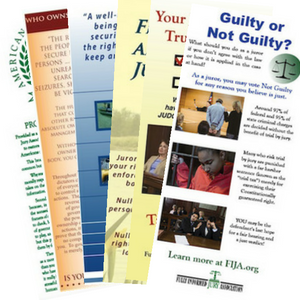
Responding to the spread of education on jury nullification, the Department of Justice recently declared that it "takes jury nullification and interference with official proceedings extremely seriously." And that, "Any group attempting to improperly influence juries who should serve as impartial arbiters of evidence should be held accountable."
Such bombastic authoritarian declarations are, of course, absurd. Conscientious acquittal -- jury nullification -- is a core right built into the jury system, and repeatedly praised not just by the founders but by sitting supreme court justices. Educating jurors about this right should be the *obligation* of every courthouse, and activists distributing FIJA literature on one's rights is basic free speech.
Federal law (18 U.S.C. § 1503) prohibits intimidating any juror, but public education is not intimidation. If the justice department wants to look into juror intimidation, they would have to apply that statute -- as it almost never is -- to judges themselves.
Recently the musician Afroman obtained some fame when local police sued him for music videos mocking individual officers involved in a groundless invasion and ransacking of his house. Americans from across the political spectrum united in recognizing this as a basic free speech case, and Afroman's jury agreed. Yet after the acquittal, the judge in the Afroman case yelled at jurors, demanding to know what went wrong and why they voted the way they did.
FIJA has long documented the various ways that judges apply pressure in addition to outright lying to jurors, implying legal liability and severe consequences for thinking for oneself rather than dancing like a marionette to the judge's instructions. Recently in the UK -- where the Labour Government is trying to abolish juries -- Judge Silas Reid threatened jurors that using their conscience in judging a case involving environmentalists would constitute a crime. In the US, we have the Allen/"dynamite" charge -- a legally sanctioned version of pressuring jurors who can't agree by effectively browbeating them and issuing them ever more narrow instructions.
But judges are often more crude in their intimidation. Infamously, in the foundational Bushell's Case, when jurors refused to convict William Penn the presiding judge was livid and imprisoned them without "meat, drink, fire, or tobacco" to coerce a guilty verdict. This tradition of tantrums is still with us, in 2019, for instance, Judge Scotti "threw a book against the wall, cursed, and berated, yelled at, and threatened a prospective juror" during voir dire.
Most judges were former prosecutors who rose through a culture of coercion and force, winning at almost any cost. As top dog in the courtroom, a judge has rivals — those pesky 6 to 12 people in that box off to the side who, for any reason they see fit, can let the people dragged into your courtroom go free. For centuries judges have resented that their total power has been usurped by juries, and they repeatedly demonstrate every desire to bully and mislead jurors, lest they realize they are actually the most powerful people in the room.
But judges aren't the only source of regular juror intimidation. Part of the reason we say that jury duty is for heroes, is that sticking to one's conscience in a jury box can involve a great deal of harassment from other jurors.
In a recent high-profile case of Texas activists accused of "terrorism" for widely varying levels of connection to a noise protest where one attendee discharged a gun, it's alleged that there was sustained furious yelling during juror deliberations, and when the jury returned the guilty verdicts pushed by the judge, some jurors were sobbing.
In a 2009 trial, a mistrial was finally forced after a severe situation where one juror holdout wrote to the judge that "I am being intimidated, threatened, screamed at, as well as verbally insulted that I am stupid because I do not agree. I have had 2 physical threats against me, a chair thrown and a verbal threat to beat me up."
Even more extremely, in the 1990 trial of Madison Hobley for murder, the jury foreman, a police officer, produced a gun, laid it on the jury table and announced "We'll have a verdict." The jury was sufficiently intimidated to convict, but this apparently wasn't enough to declare a mistrial, and he had to be pardoned later after it was revealed that the police had used torture to extract confessions.
Sadly, very little research has been done in tracking intimidation within the jury box. In the US, jurors generally cannot formally testify after the fact about what happened during deliberations. The rule is positive in many respects and exists to promote finality, protect jurors from harassment, and preserve the sanctity of deliberations. But it opens the door to consequenceless bullying, harassment, and threatening behavior from jurors "who just want to go home" against holdouts committed to their conscience.
The most comprehensive study among nations inheriting English common law is from Australia, where Judith Fordham used questionnaire data from 913 jurors across 218 randomly selected trials, plus 58 jurors from 17 targeted trials with prior allegations of intimidation, and in-person interviews with 130 jurors. She found that 14.3% of jurors in the random sample reported feeling uneasy, threatened, or unsafe during or after their trial. The study's most striking finding was that the most common source of intimidation was not defendants or outsiders, but fellow jurors, and this intra-jury coercion was also the most effective — in 8 of 11 documented cases where intimidation caused a juror to change their vote, the pressure came from inside the jury room. Beyond outright intimidation, 14.2% of jurors reported discomfort with offensive statements by other jurors, 12.9% with other jurors shouting, and 15.7% with other jurors emotional intensity.
In short, we have every reason to believe that jurors regularly face pressure and intimidation, and yet these are too often not considered "improper." Activists handing out pamphlets or giving public talks on one's rights are the very last people the "justice" department should be concerned about.